


For decades, the midsize pickup segment has been one of the most hotly contested corners of the American market. Ford, Chevrolet, GMC, Nissan, and Jeep have all taken their swings, each promising the right balance of capability, comfort, and value. Yet in 2025, something unusual happened. Instead of a tight fight at the top, one truck surged forward so decisively that the rest of the field suddenly looked a step behind.
That truck is the all-new Toyota Tacoma.
The Tacoma has always been a sales leader, but dominance and inevitability are two different things. Previous generations relied heavily on reputation—bulletproof reliability, strong resale value, and a loyal owner base that rarely defected. The 2025 model changes that equation entirely. This is no longer a truck surviving on legacy. It is winning on merit, execution, and timing.
A Ground-Up Reinvention That Actually Matters
Toyota didn’t treat the 2025 Tacoma as a mild refresh. It was rebuilt from the frame up, riding on the new TNGA-F architecture that also underpins the Tundra, Sequoia, and Land Cruiser. That move alone reshaped the truck’s personality.
The new platform delivers a stiffer chassis, improved suspension geometry, and a more planted feel both on pavement and off it. Where older Tacomas could feel busy or unsettled over rough roads, the new truck feels composed and deliberate. It drives like a modern pickup, not a holdover from another era.
That structural upgrade gave Toyota the foundation it needed to modernize everything else.

The End of the V6—and Why Buyers Don’t Miss It
Perhaps the most controversial move was Toyota’s decision to drop the long-running naturally aspirated V6. In its place is a turbocharged 2.4-liter four-cylinder, offered in multiple outputs depending on trim.
On paper, some traditionalists balked. In practice, the new engine delivers exactly what truck buyers actually use every day: torque.
The turbo four produces more low-end pull than the old V6 ever could, making towing, merging, and trail crawling noticeably easier. Power delivery is stronger where it counts, and the engine feels more responsive in real-world driving.
For buyers who want even more capability, Toyota’s i-Force Max hybrid system takes things several steps further. By pairing the turbo engine with an electric motor integrated into the transmission, the Tacoma gains substantial torque while also improving efficiency. It is not a fuel-saving gimmick—it is a performance solution designed around workload.
In an era where emissions regulations and fuel costs shape engineering decisions, Toyota managed to move forward without sacrificing capability. That balance is something several competitors are still struggling to achieve.

An Interior Built for Use, Not Just Show
Inside, the 2025 Tacoma reflects a clear philosophical shift. Toyota didn’t chase luxury for its own sake, nor did it strip the cabin bare in the name of toughness. Instead, it focused on function.
Materials feel durable without being cheap. Controls are laid out logically, with physical buttons retained where they make sense. The driving position is more upright and truck-like, addressing a long-standing complaint about earlier Tacomas.
The infotainment system finally feels contemporary, with faster response times and clearer graphics. Digital gauges are configurable but not distracting. Importantly, the tech enhances usability rather than dominating the experience.
This is a cabin designed for long ownership—one that will still feel intuitive after years of daily use, trail runs, and jobsite miles.
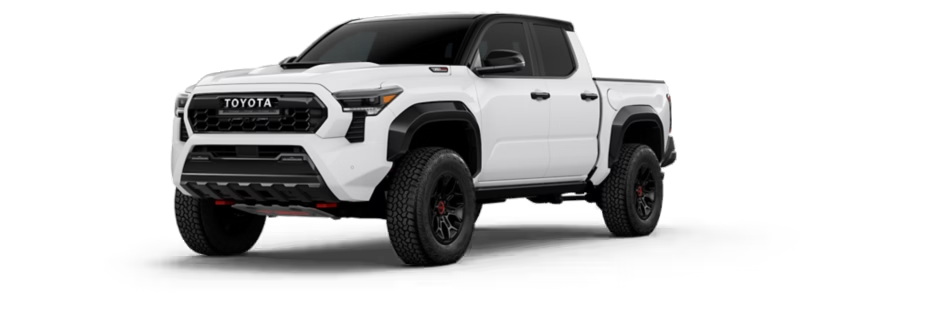
Factory-Built Off-Road Weapons
Where the Tacoma truly separates itself is in how comprehensively Toyota addressed off-road buyers.
The TRD Off-Road remains the backbone of the lineup, offering locking differentials, terrain management systems, and suspension tuned for real trail use. It is a legitimate off-road truck straight from the showroom.
The TRD Pro pushes further, adding specialized dampers, increased ground clearance, and aggressive factory tuning developed with desert running in mind. This is not an appearance package—it is a performance trim with a clear mission.
Then there is the Trailhunter, perhaps the clearest signal that Toyota understands modern truck culture. Built specifically for overlanding, it comes equipped with heavy-duty components, steel protection, integrated accessories, and a layout designed for long-distance exploration.
Instead of forcing buyers into the aftermarket immediately, Toyota brought the aftermarket mentality into the factory. That approach not only improves reliability but also preserves warranty coverage—an enormous advantage for serious users.
Why the Competition Fell Behind
The Tacoma’s success isn’t just about what Toyota did right. It is also about where rivals stumbled.
Some competitors chased comfort too aggressively, blurring the line between pickup and crossover. Others delivered strong engines but struggled with long-term reliability perceptions. A few simply lacked cohesive trim strategies, offering packages that looked good on paper but failed to resonate with real buyers.
When shoppers began comparing total ownership experience—durability, resale value, aftermarket depth, and proven dependability—the Tacoma’s advantages compounded quickly.
Toyota didn’t need to be the flashiest option. It only needed to be the most complete one.
The Result: Market Momentum That Feels Inevitable
Sales data following the Tacoma’s redesign made the message clear. Buyers didn’t just approve of the changes—they embraced them. The truck’s lead over its rivals widened, not narrowed, despite aggressive updates elsewhere in the segment.
This is not a temporary spike fueled by novelty. It reflects long-term trust reinforced by modern execution. Toyota listened to criticism, addressed weaknesses, and delivered a truck that feels purpose-built rather than compromised.
The midsize truck war may continue on paper, but in practice, the 2025 Tacoma has forced every competitor to recalibrate.
Right now, it isn’t just winning.
It’s defining the standard.


